
Helen C. Neave, Founder and Director, Make it Wild
22nd September 2026
Since 2010, Make It Wild has been giving land back to nature across North Yorkshire and beyond, through woodland planting, meadow restoration and pond creation. Their flagship site, Bank Woods, is 111 acres of ancient woodland, newly planted trees and meadow above Summerbridge in Nidderdale — now recognised as a Site of Importance for Nature Conservation.
Something remarkable has been happening underfoot at Bank Woods. Recent surveys of our grasslands have revealed an exceptional richness of fungi. This is important, and of note to the rewilding community.
Beneath every grassland runs a hidden network of fungal threads, or mycelium, breaking down dead plant matter, animal dung and other organic debris, and returning nutrients to the soil. Without that constant decomposition, nutrients stay locked away rather than cycling back through the system. Many fungal species also form partnerships with plant roots, trading nutrients for sugars, a relationship that underpins the health of both grassland and woodland. Fungi keep the ecosystem running.
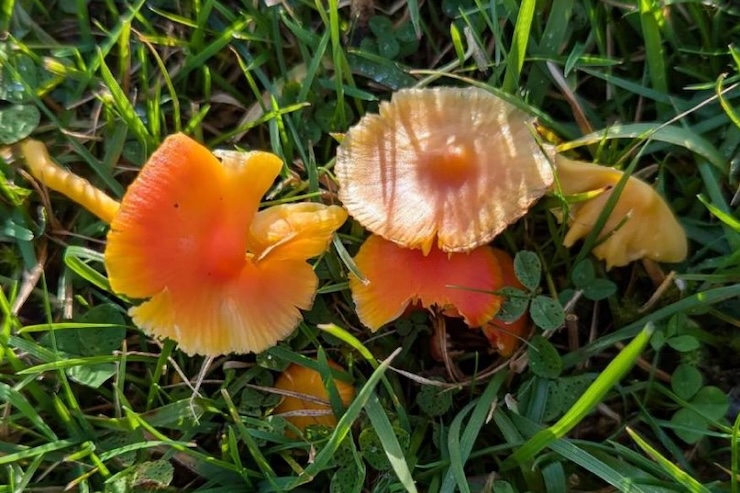
A rich diversity of fungi also tells you something about everything else. Healthy fungal networks support the invertebrates that feed on them, which in turn feed birds and small mammals. They improve soil structure, helping land hold water and resist erosion. And because grassland fungi – waxcaps especially – are so sensitive to disturbance and chemical input, their presence is hard evidence that land has been treated gently for a very long time. That is why this matters for rewilding. It is not only about bringing back big, visible species; it is also about protecting the hidden underground processes that everything else depends on. Finding this richness at Bank Woods is proof that the approach is working.
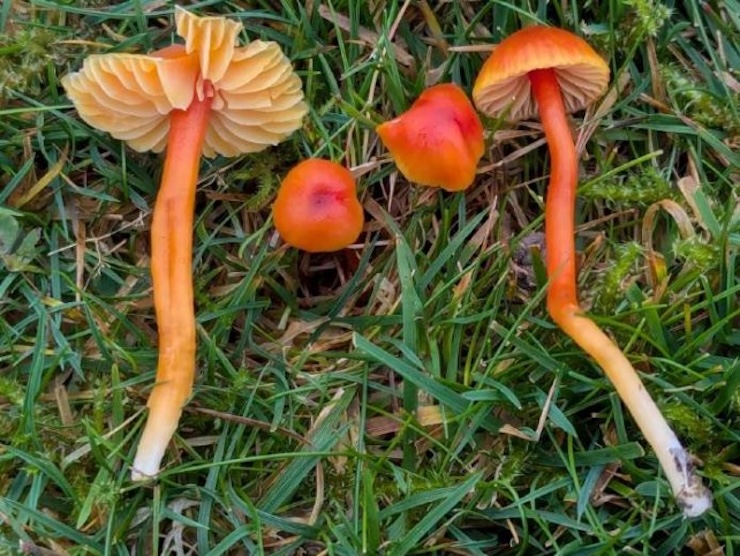
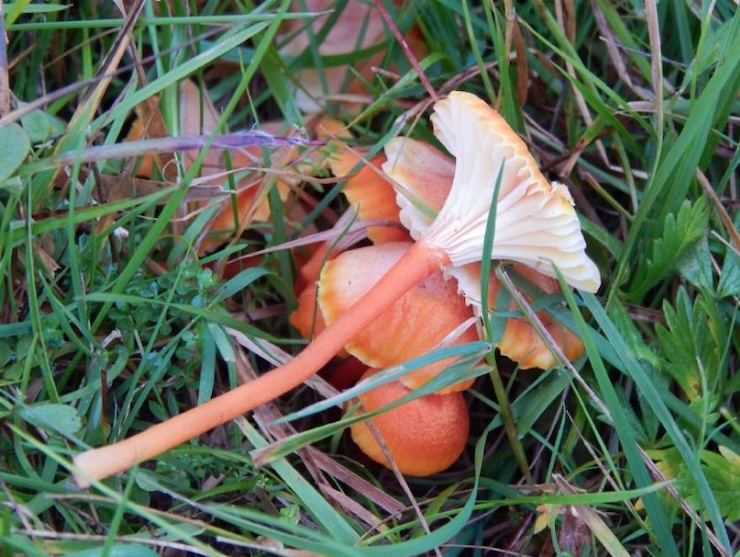
We already knew there are lots of different colours and types of waxcap on our land; they are very striking, and some of them are very numerous. They are always a feature of our Foraging Days, because they are relatively unusual, and many participants have never seen them before. Additionally, they are beautiful, locally very abundant, and edible.
In December 2025, a visiting expert, Steve Hindle, studied the grasslands of our rewilding area, and a few other fields which are grazed intermittently and at low density by the cows and occasional sheep of a tenant farmer.
To our delight, Steve recorded 45 species of fungus across our whole site. Eleven of these are listed as ‘Vulnerable’ by the International Union for Conservation of Nature. This puts them on the same standing as the polar bear and the hippopotamus.
The 45 fungi included 25 species of waxcap mushrooms. He told us that 19 species is the threshold for a site to be recognised as a Site of Special Scientific Interest (SSSI), which was amazing news. It was a piece of scientific evidence in support of our rewilding land management methods.
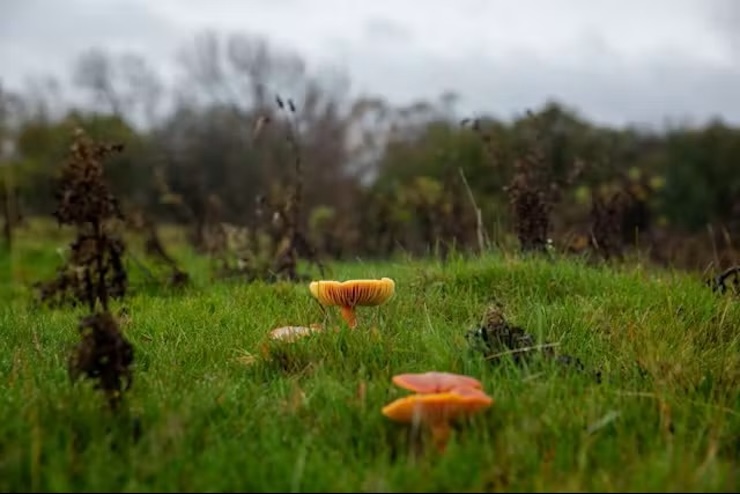
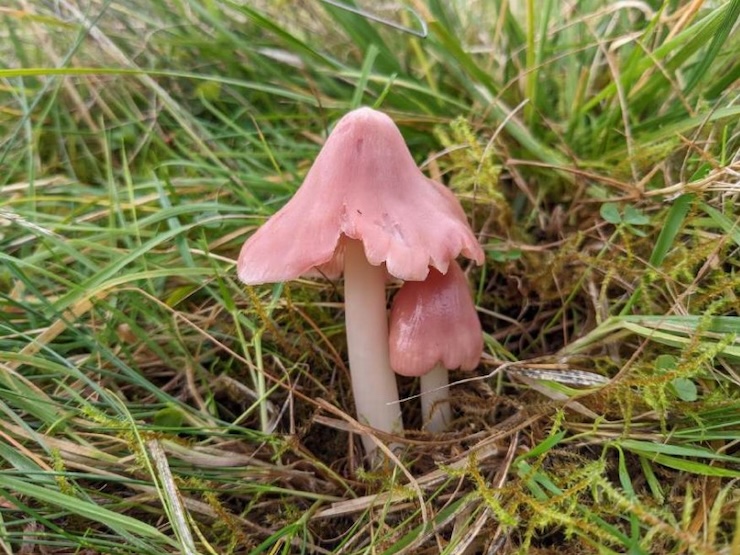
To quote Steve: “I was delighted to discover so many important types present at this site, such as the brightsky pinkgill, which is a UK priority species for preservation. Moreover, this location is internationally important for waxcap species. So many of the habitats where these mushrooms have traditionally been found in Europe have been lost or degraded. This can be due to disturbance from ploughing, the use of agrochemicals such as fertilisers and fungicides, poaching, or encroachment of scrub and trees. This makes it even more important that the grasslands at Bank Woods continue to be actively managed to preserve their rich biodiversity.”
Steve gave the following specific guidance on land management to look after the precious fungi:
1. Avoid physical disturbance
The land that was surveyed has never been dug or ploughed as far as we are aware. We will continue to avoid digging, ploughing, machinery, large groups of people, too many animals, or heavy animals grazing when the ground is moist. All of these are damaging to the important fungi.
2. Avoid chemical change – maintain low nutrient levels
Any influx of nutrients would cause less selective species to thrive, and potentially therefore lead to the loss of the waxcaps. We don’t use any agro-chemicals such as fertiliser, lime or fungicides. We will also be mindful of the impact of dung or manure. The species make-up can also be upset by changes in light levels, through nearby tree or hedgerow growth, so we will particularly control the spread of gorse in the rewilding area. We also need to watch for increased soil water levels with poor drainage, which would be likely to lead to soft rush encroachment.
3. Control competition
Grassland fungi are restricted to grasslands which are low in nutrients. If trees are present with mycorrhizal fungi, these will outcompete the fungi as their capacity for accessing nutrients is much greater. This leads to a buffer zone around trees reaching as far as the roots, roughly equivalent to the height of the tree.
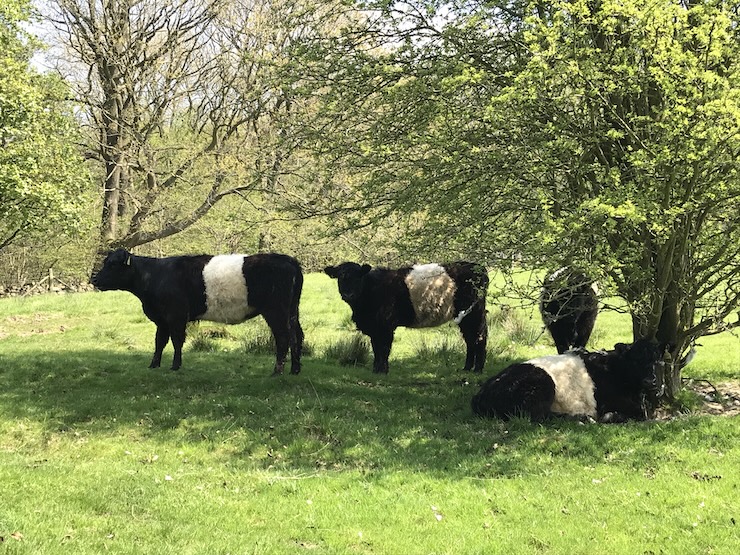
Steve went on to confirm that the current low-density grazing by belted Galloways in our rewilding area is ideal, for both for the fungi and botanical diversity.
These results from Bank Woods are clearly important beyond the site itself. They demonstrate that nature recovery can happen where land is managed in tune with nature, and with care rather than force.
Further information
- To read more about Make it Wild, visit the website: www.makeitwild.co.uk
- A more detailed blog about the Meadow Fungi Survey, with links to the report, can be found here.
[Image Credits: © Make it Wild