
by Alison Organ
21st June 2026
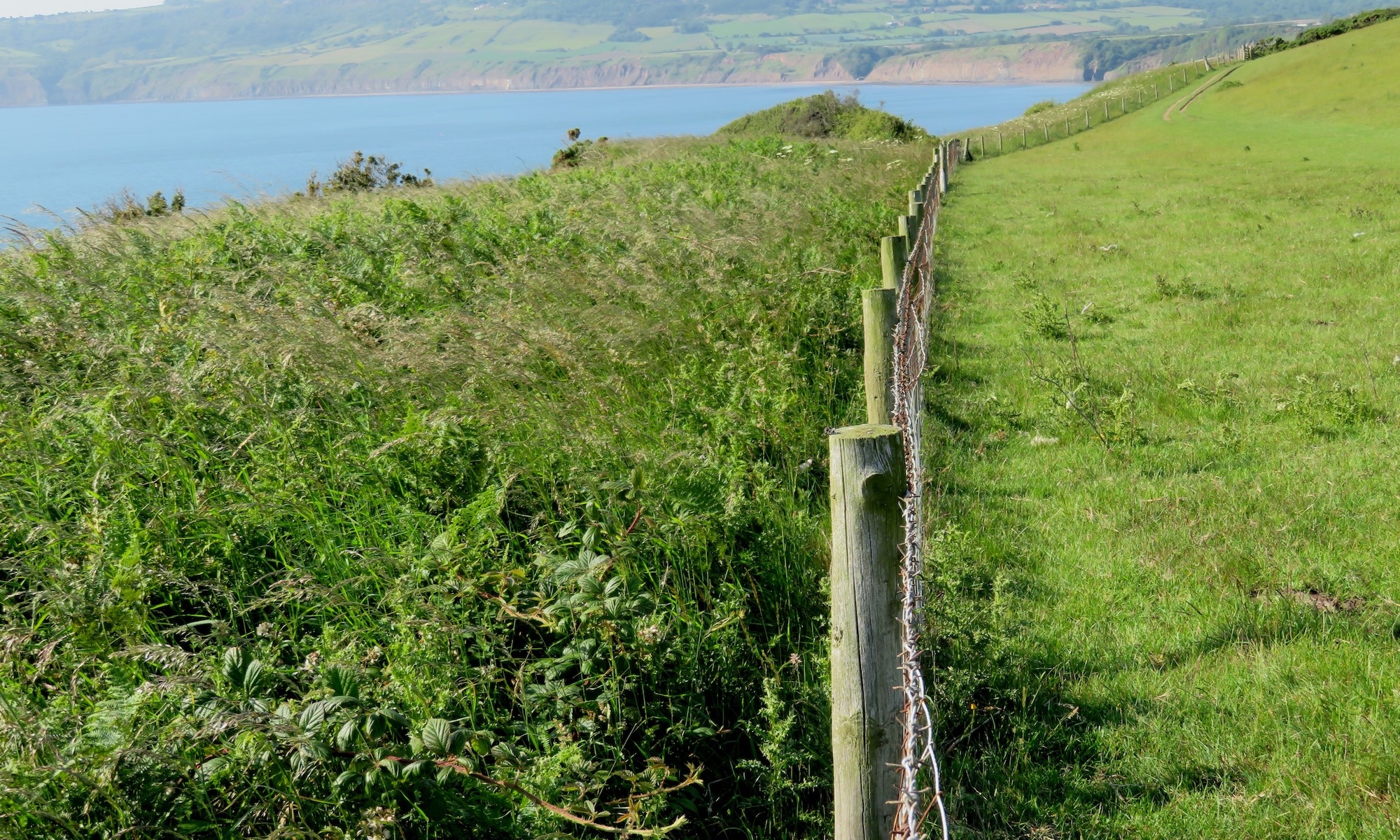
A lot has happened since Long Lands Common in Harrogate joined the Yorkshire Rewilding Network in 2020. Here, key volunteer Alison Organ gives an up update on the expansion of the project and all that the community has achieved since they were featured in the winter 2021 edition of our newsletter..
When it was founded, Long Lands Common was a 30-acre site on the outskirts of Harrogate. The aim was to create a community owned woodland and accessible-to-all public green space that would help to protect and preserve the greenbelt between Harrogate & Knaresborough, enhance the biodiversity of the area and contribute to the wider Northern Forest tree-planting ambitions.
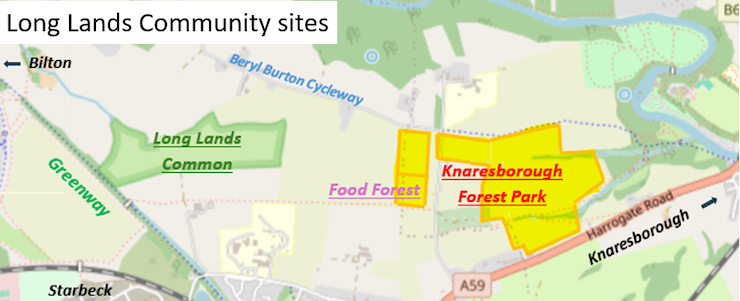
One of our mission statements was to buy more land to protect the green belt between Harrogate and Knaresborough, and this aim was realised in 2025 when we acquired a further 60 acres, now named Knaresborough Forest Park. The newly named Long Lands Community has the aim of protecting the sites to enhance their biodiversity, both through natural regeneration and planting, as well as creating a space for education and recreation for the people of our towns, now and into the future.
Long Lands Common
After securing the site, a number of baseline surveys gave us a better understanding of the natural assets of what had become impoverished grazing land. An early decision was to lend assistance to the natural processes that would both increase opportunities for enhanced biodiversity and also for human activities. Rewilding in its purest form would not be practical in this small-scale peri-urban location, so it has been necessary to balance interventions with letting things happen naturally.
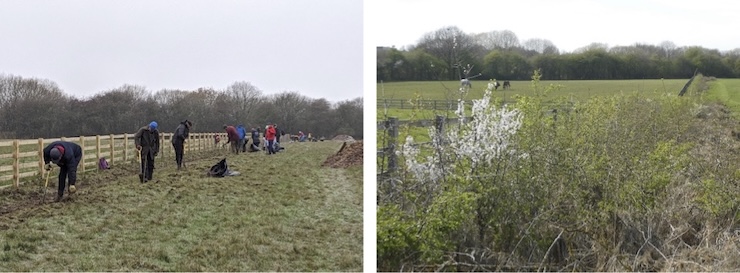
One of the first tasks was to mask the fencing bordering the site with a hedge, running the full 250m of the fence. This was planted in 2022 and is now well established and blooming.
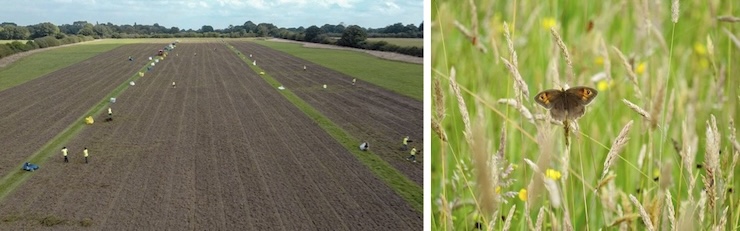
We wanted to increase the biodiversity of the two arable fields which we had acquired, so in 2022 we undertook a mammoth sowing of wildflowers. To achieve this, we harrowed a large area of the field and spread green hay laden with grass and wildflower seeds, which we had harvested ourselves by scythe from a donor site. As you can see from the photos, these are now blooming and attracting wildlife.
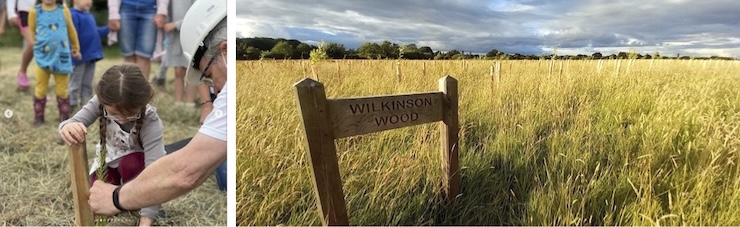
So far, we have completed two phases of tree planting, in collaboration with White Rose Forest, funded by the government’s ‘Trees for Climate Change’ policy. The first wood, planted in 2023, was named Wilkinson Wood after local conservationist Keith Wilkinson, and the second, planted over two sessions in late 2024 and early 2025, was named Forster Wood after Piers Forster, Professor of Physical Climate Change at the University of Leeds, both of whom have contributed immeasurably to the protection of our natural world.
There are plans for growing hazel and sweet chestnut for coppicing, such that we will have planted over 9,000 trees, sequestering carbon, restoring soils and creating opportunities for woodland craft activities.
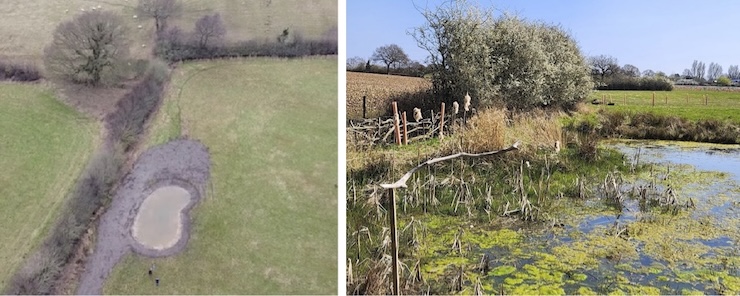
We were thrilled that Yorkshire Wildlife Trust identified three areas suitable for ponds to attract great crested newts, along with other aquatic life. These were dug in 2021 and are now teeming with life.
Knaresborough Forest Park
In Knaresborough Forest Park we acquired a very different sort of site. Whereas Long Lands Common was a blank slate to draw on and increase its biodiversity, Knaresborough Forest Park was already an established and very varied habitat, with two gullies, lush grassy meadows and a common. While we do have plans for the different areas, which we are developing in consultation with ecologists and shareholders, it is already a species-rich site which we need to protect.
Another difference is that while Long Lands Common is tucked away off the Greenway in Harrogate, accessed only by a footpath (unless you contact us for disabled access), Knaresborough Forest Park is bordered by the A59 on one side and the Beryl Burton Cycleway on the other, so it is accessible on foot or by bike or bus, and has a public footpath running through it. While this provides exciting opportunities for outreach and education, it also means that we will have to choose which areas are suitable to develop as areas for the community to enjoy, and which we want to shield to protect the wildlife.
We have worked again with White Rose Forest’s Trees for Climate programme and have started with a small-scale planting of hazel for coppicing, to provide a source of income for us, and canes for local gardeners and allotment-holders so they do not need to invest in imported bamboo. We used biodegradable tree shelters made from British woodchip and wood resin. This newer type should last longer than earlier versions which tended to degrade too soon. We have also planted willow to sell to local willow-workers.
Alongside these ‘cash-crops’ we have also planted riparian trees such as alder, willow and bird cherry along the ghylls, and field maple and rowan in the wood meadow.
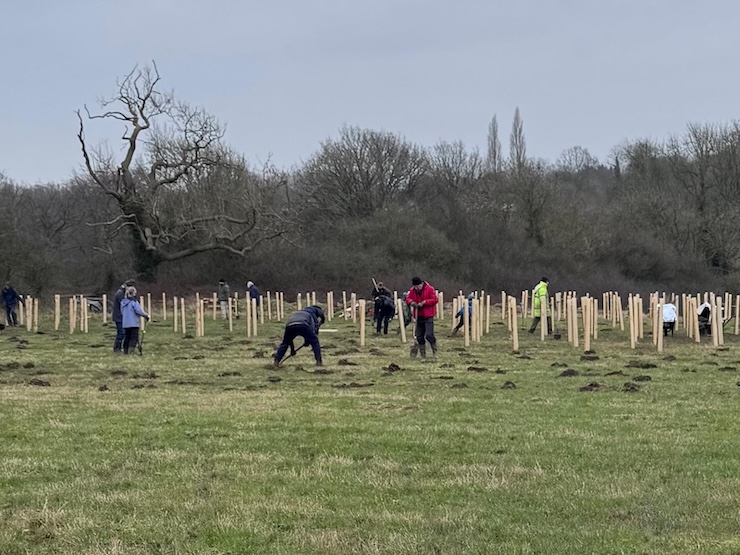
This planting aligns with the North Yorkshire Council Local Nature Recovery Strategy which has identified a priority for our area to “increase tree and woodland cover by enhancing all types of existing woodland and creating new species-diverse woodlands” and “create and expand wood pasture habitat as an appropriate buffer and connecting habitat between woodland and grassland sites”.
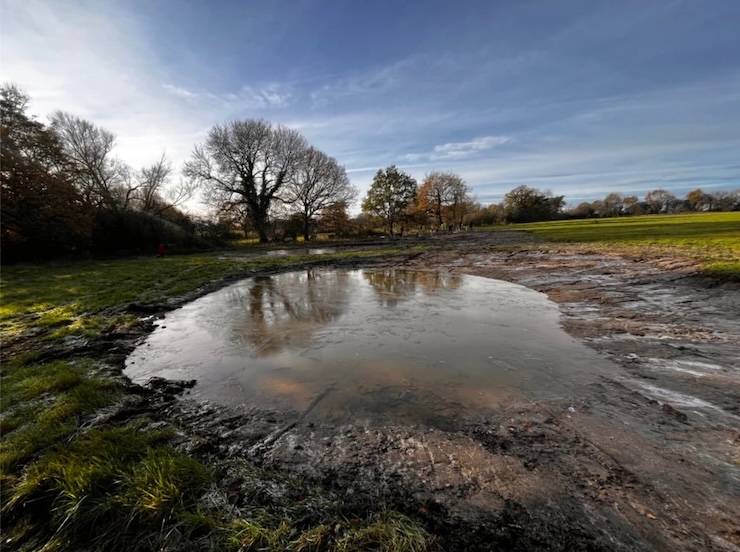
We have also worked with Yorkshire Wildlife Trust again, who have dug four new ponds. These are very raw as yet, but we are confident they will soon be colonised by wildlife as the Long Lands ones were. They are already attracting dragonflies and mandarin ducks.
Alongside this planting, there are areas we are allowing to regenerate naturally. The aim of the riparian planting is to widen the gullies for protection, as they are the richest habitats on the site. At the foot of the large common in the middle of the site, we inherited a large area of grass not mown for 15 years. This is now rewilding naturally with large areas of hawthorn scrub over tussocky grass, reminiscent of African savannah. The preservation of hay meadows to support ground-nesting birds is important too.
We also have two meadows of unsprayed hay and wildflowers which are protected from the public as we have skylarks nesting there.
Our plans for the future include further riparian planting, mixed woodland and scrub, more hedges, a shelter belt, scrapes and the creation of wet woodland by re-establishing water sources which had been culverted when the land was farmed.
If you would like more information, see our umbrella website below, which gives you access to the websites for each site, including the journal page on the Knaresborough Forest Park website which provides ample evidence of the work going on there.
The Long Lands Community has secured 90 acres of Green Belt for perpetuity, a 2km natural corridor between Bilton and Knaresborough which is a highly valued community asset that will continue to surprise us as nature grows back.
Further information
- You can find out more about the Community here.
- To contact the Long Lands Community team, email info@longlandscommon.org
- See the Local Nature Recovery Strategy for North Yorkshire and York here.
- Along with the draft LNRS Local Habitat Map here.