
James Wood
22nd June 2026
Laver House Farm in North Yorkshire is a delightful 13acre site being rewilded by YRN committee members Su and James Wood. Here, James talks about hedgerows from a rewilder’s point of view.
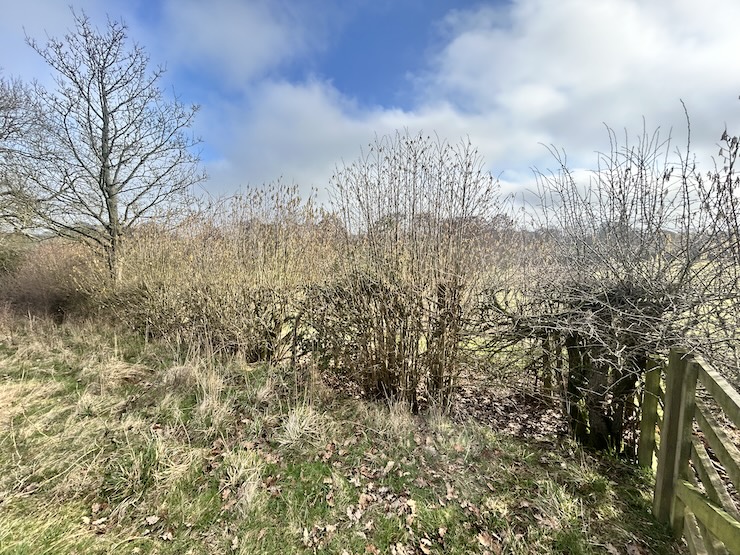
Although hedgerows are a human invention, they mimic the scrubland that was prevalent prior to agricultural clearances. According to the RSPB ‘hedges may support up to 80 per cent of our woodland birds, 50 per cent of our mammals and 30 per cent of our butterflies’. They act as highways for nature, linking habitats together. However, the common picture is one of a harshly flailed or remnant hedge, providing little in terms of protection, food or stock-proofing. In contrast, a healthy hedgerow is made up of a variety of shrub species, has a dense structure and is of a good, thick width with margins either side of scrub and wildflowers.
To maximise the benefits for wildlife, intervention is required, by proxying the large herbivores that used to roam the land. Trees and shrubs evolved with these missing grazers, responding to damage with vigorous regrowth. Without intervention, the base of a hedge becomes hollow and gappy, and eventually becomes a series of trees. Whilst this still has an ecological value, it does not match the diversity provided by a healthy hedge.
The hedges at Laver House are old. Most of the land is described as the Old Laverton Inclosure on a 1780 enclosure map and field boundaries are unchanged from the Tithe Map of 1838. Some of the inclosure boundaries are largely grown out, where ditches and wet ground have hindered mechanical cutting. The internal hedges show signs of previous flailing, with dense knuckles of scar tissue and gappy bases.
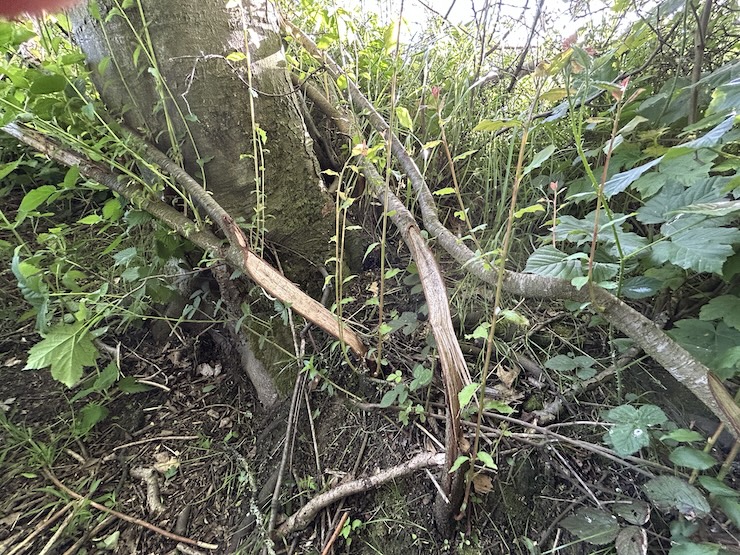
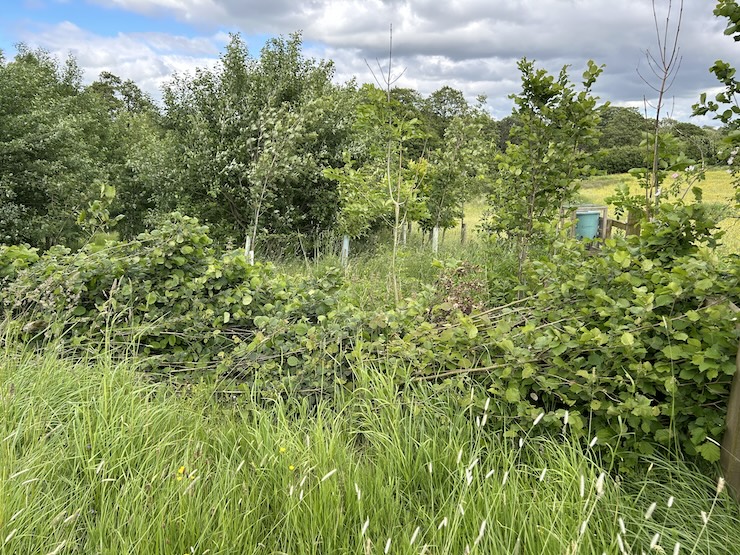
Inspired by the work of Jonathan Thompson at Underhill Wood Nature Reserve and Christopher Hart (Hedgelands, 2024), I decided to have a go at rough hedge laying. Hedge laying is a proxy for grazing by large herbivores. It involves cutting through most of the stem near the base and laying the shrub at an angle along the line of the hedge (pleaching). This encourages the plants to sprout new growth from the base and dormant buds, creating a dense barrier. Traditional hedge laying removes most of the growth, providing a narrow hedge which is then staked and bound at the top. An alternative is rough (also known as ‘conservation’) hedge laying, which only removes as much growth as is necessary to gain access to the base. The resulting hedge, as Hart explains, ‘will be spikier, scruffier and wider’.
Traditional hedge laying is a skilled job, but much of the skill is in the neatness of the result – a straight, level hedge with equally spaced stems at a constant angle and equal lengths of pleach or cut. Rough hedge laying needs none of this, but there is some skill in the pleaching cut, allowing the stem to push over without breaking. Any areas of hedge with older plants without suitable limbs for laying can be coppiced and laid after a few years of new growth.
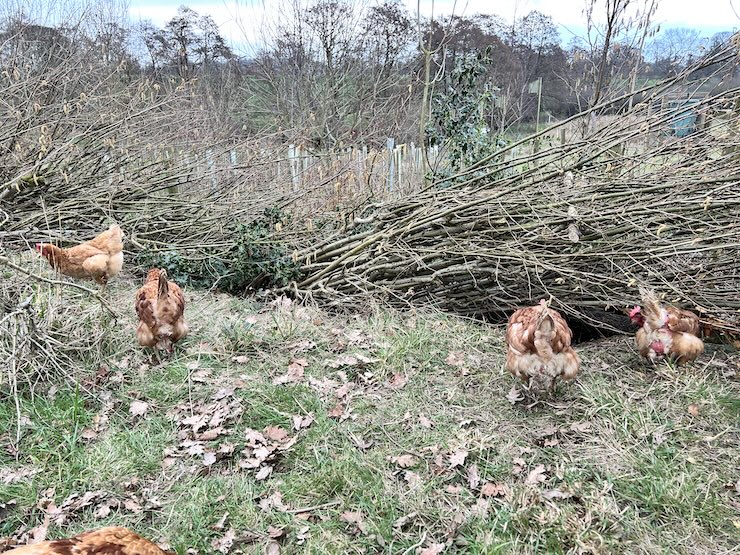
Hedge laying can take place out of the nesting season, between September and March. I’ve so far made a small start on our internal hedges, and I’m planning to do each hedge over a number of years, ensuring that there are not long lengths without fruit or disruption to bat flight paths. Although much of what I did only took place in February and March of this year the resulting thick hedges are already looking impressive and the display of hawthorn and blackthorn flowers in May was the best that we’ve seen in our time here. We’ve also allowed the blackthorn to sucker in places providing scalloped edges, further mimicking scrubland and increasing the range of temperature, humidity, sunlight and wind exposure along the length.
Nothing has been wasted, with brash creating dead hedge barriers between the vegetable garden and the orchard, or sinuous snakes running between trees in the woodland.
Finally, thanks to Jill from the YRN Small Scale Rewilders group for arranging a day with the Leeds Coppice Workers which was great for learning how to use a traditional billhook. I’m almost looking forwards to the winter, when I can start laying again, but in the meantime I’ll enjoy the fruits of my labour, watching and listening to the flourishing biodiversity.
Further information
- Hedgelands: A wild wander around Britain’s greatest habitat, by Christopher Hart (17 Jul 2025)
- Leeds Coppice Workers
- Illustrated guide on how to interpret the state of a hedgerow
[Image Credits: James Wood]