Kate Graham visits Emma and Rob Burnett to see how they’re doing things differently at Bogridge Farm.
By Kate Graham
20th July 2026
“I was given this book, Wilding – you know, by Isabella Tree.” Emma Burnett of Bogridge Farm tells me how she discovered rewilding. Once again, I give thanks to Isabella Tree for writing this book and writing it so accessibly. Rewilding projects vary from small gardens through to grand landscape-changing schemes. This one is not a project but a livelihood: two people creating a way of living that they cope with. Each rewilding project is a unique reflection of the motivation of the people behind it, the relationship they have or wish to have with the land. This is the story of one such relationship.
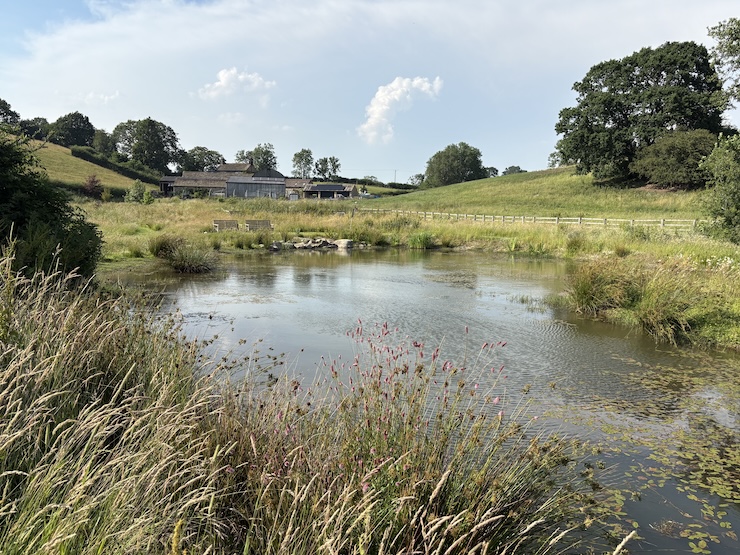
Bogridge Farm sits above Lower Wharfedale, comprising 96 acres of pasture, together with a small, largely oak wood. As its name suggests, it is on clay, with plenty of wet bits. To reach the farm, I follow a narrow lane winding through shady trees, suddenly emerging into open rolling fields. At the farm gates the brightness of a green woodpecker surprises me, yellow and green flashing in the sunlight.
Emma and Rob Burnett took over responsibility for the farm from Rob’s parents some 40 years ago, working in catering and building a successful garden business to make ends meet. They were eventually able to buy the farm and have developed two of the farm-buildings into holiday cottages.
After reading Wilding, inspired and curious, they decided to embark on their own bit of full-scale rewilding, creating a wildlife corridor from existing hedgerows and ditches, digging a large pond in one of the more substantial wet bits on the property, and investing in a small herd of pedigree longhorn cattle. As they developed the farm to be more in harmony with nature, their rewilding vision grew into an effort to find a way of farming that the two of them could manage, that fitted the size of the farm, and was sustainable for the land and nature’s recovery.
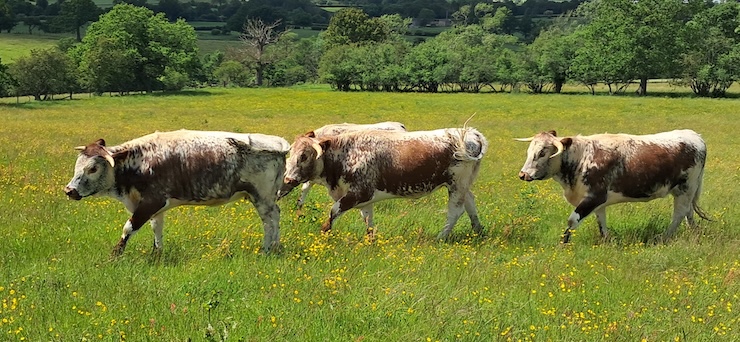
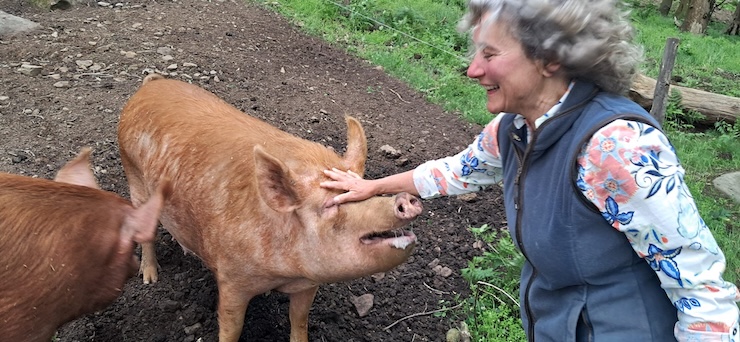
As we walk through lush buttercup and clover meadows, they point out footpaths and bridleways crossing their land. That’s fine for the cows and their beautiful bull, despite the big horns, but it means that their Tamworth pigs – well known for their escape artistry – are better kept fenced in.
The meadows are rough underfoot, and Rob explains that – unlike in the arable fields in the valley below us – they don’t roll, plough or prepare the ground in any way, or add fertiliser or pesticides. They haven’t tested soil quality and depth to measure how it might be changing, but their sense is that it’s becoming more resilient to drought. My untrained eye enjoys seeing so many different plants and flowers around us, and the swallows diving and dancing above the meadows.
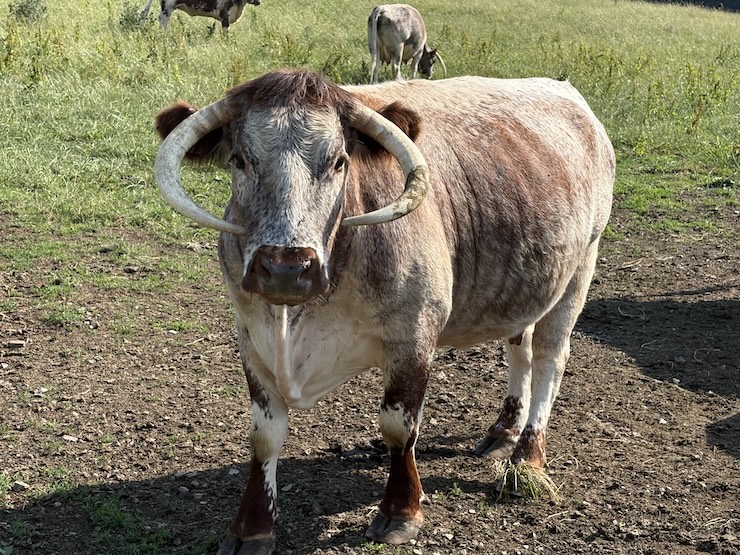
I haven’t been up close to a longhorn before, and I find myself utterly transfixed by them. They do have spectacular horns, but they seem gentle, wary and friendly – and they didn’t mind having their photo taken. The herd is getting to the point where it’s reaching the capacity of the land to allow it to continue to be rotated round the field, keeping the cattle grass-fed throughout the year. A common criticism of rewilding is that it reduces land productivity. When I ask Rob about this, he points to the bigger picture. They certainly have fewer cows at Bogridge Farm than they would if it was farmed intensively, but it also means there’s no need for fields of crops to be grown to feed them, no fossil fuel inputs, and no fertilisers. There’s less beef being produced, but it’s also costing less, with a much lower carbon footprint. It’s hard to make conventional livestock farming pay, and higher-density farming would continue to drain and pollute the land. Emma and Rob’s approach is productive in many more ways than can be measured purely by the beef they produce. And it’s manageable by the two of them.
They sell their bullocks at market, and are venturing into beef sales, probably starting with friends and contacts and then aiming to build a local market. Selling locally should be manageable and flexible. The heifers are reared for breeding, and will be sold on.
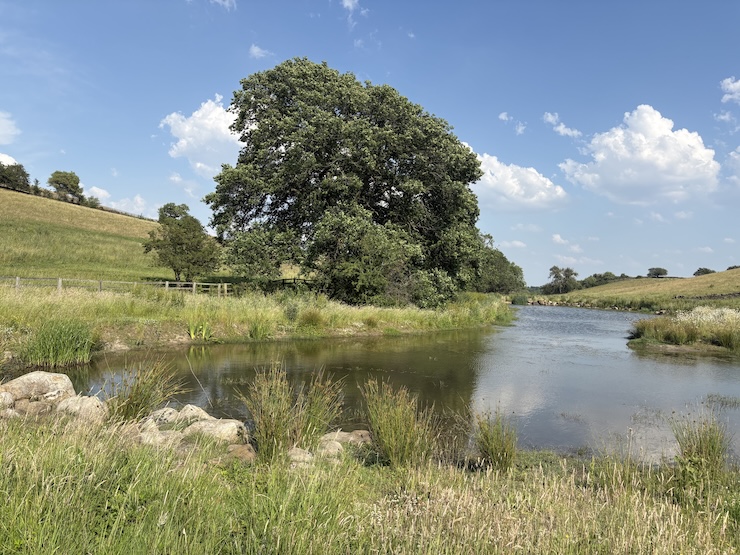
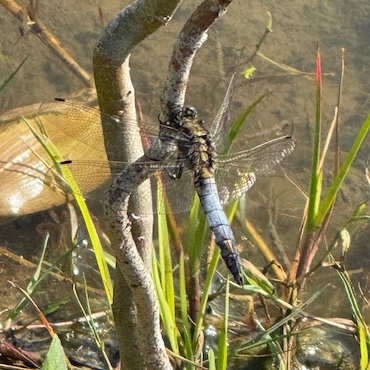
We walk up to the wood past their large pond, teeming with insects and a growing family of wild geese. Docks sprout furiously from the disturbed soil, leaving a dilemma as to what, if anything, should be done about them. The oak wood is home to the adult pigs: two sows alternating with the boar, each in a large moveable run under the trees, one with access down to a pond. They call them out to say hello, and I’m impressed, as I retreat, by just how huge (and curious) they are. They’re successfully selling pork boxes, again locally direct from the farm – and these are definitely happy pigs.
As well as being part of YRN, Emma and Rob are members of Pasture For Life, a non-profit run by farmers for farmers who want to farm in harmony with nature. They believe the way they’re stewarding their pastures is improving biodiversity as well as soil quality. They take me to see their first orchid, standing proud on a grassy slope. I notice small oak seedlings everywhere, and small hawthorns are emerging, strong and prickly. They plan to plant some more oak trees, to provide wooded pasture in years to come.I came away feeling uplifted and inspired by the joy of meeting two committed, very hard-working people, a vibrant landscape and happy animals. They’re doing what they have the capacity to do, and what is sustainable as they get older. They don’t know whether their own children will wish to continue farming, but their vision is of a livelihood for now, and land that will be enriched, rather than depleted, for future generations.
Further information and helpful links:
- Pasture For Life
- To book one of the cottages see here.
- To enquire about a meat box, please contact Emma Burnett directly on 07943 657568 or by email to info@rsburnett.co.uk